
Every few years, something shifts underneath digital marketing so quietly that most practitioners only notice it after their traffic reports start looking strange.
This time, it is not an algorithm update or a policy change. It is something more structural: the way people search is changing, and neither SEO nor Google Ads is immune to what is coming next.
If you have spent the last few years confidently advising clients on organic vs paid split, or managing a hybrid strategy across both channels, this is worth sitting with. The SEO vs Google Ads debate is not going away but the frame the industry has used to evaluate these two channels is quietly becoming incomplete.
The Question Professionals Are Not Asking Loudly Enough
The standard debate goes like this: SEO builds compounding organic traffic over 6 to 12 months. Google Ads gives you traffic today but stops the moment your budget does. Use both, leaning toward SEO long-term for better ROI; allocate 60 to 40 in favour of ads early on, and rebalance as organic rankings mature.
That framework is still broadly sound for most Indian businesses right now.
But here is what it assumes: that a search query always ends with a user clicking a blue link. Organic or paid, both channels depend on that click happening.
Generative AI is beginning to break that assumption.
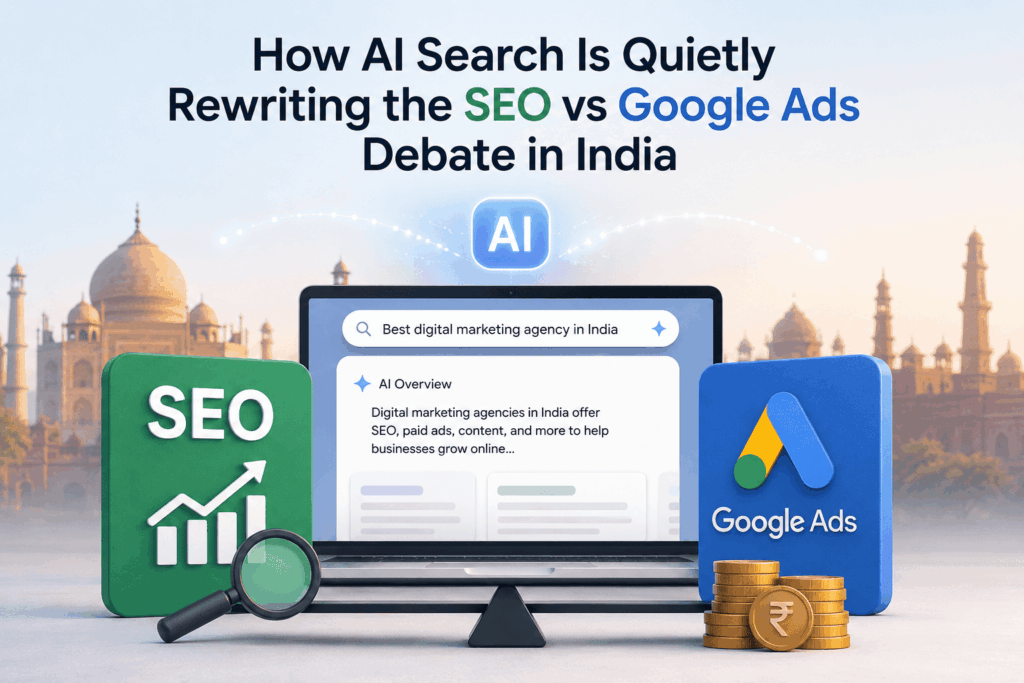
When someone opens ChatGPT or uses Google’s AI Overviews and asks which is better for a new business in India — SEO or Google Ads — they frequently get a synthesized answer directly on the page. No click. No visit. No conversion opportunity for anyone. The user got what they needed, and both your organic ranking and your paid ad were bypassed entirely.
This is not a future risk. It is a present one, and it is accelerating.
What ‘Geo’ Actually Means and Why it is Different From Seo
Generative Engine Optimization — GEO — is the practice of structuring your content so that AI systems like ChatGPT, Google’s Gemini, Perplexity, and Microsoft Copilot are more likely to surface it when generating answers.
It is not the same as SEO, though the two overlap significantly.
Traditional SEO optimizes for how Google’s crawlers index and rank pages. This newer discipline optimizes for how large language models extract, weight, and cite information when assembling a response. The signals are different. A page that ranks number one on Google for a keyword is not automatically the page that gets cited in a Gemini summary. Studies from early 2025 suggested that AI systems disproportionately pull from pages with clear factual claims, authoritative sourcing, structured data, and content that directly answers specific questions, regardless of their organic ranking position.
For digital marketing professionals in India, this creates a layered challenge. You now have three distinct visibility problems to manage.
The first is traditional SERP ranking, where SEO governs your position in Google search results. The second is AI answer inclusion, where your content structure and authority determine whether you appear inside a synthesized response. The third is paid visibility, where Google Ads still guarantees placement above organic results and, currently, above AI Overviews in most query types.
These three problems have different levers. And the mistake most teams are making right now is treating them as one.
How This Changes the Roi Math for Indian Businesses
When clients ask about SEO vs Google Ads ROI, the answer has always rested on one core argument: once you rank organically, traffic is essentially free. You pay upfront for content and optimization, but the ongoing cost per visitor drops toward zero over time.
That argument holds as long as ranking translates into clicks.
Zero-click search has been eroding this assumption since featured snippets arrived, but the scale was manageable. SparkToro’s research in 2024 estimated that roughly 60 percent of Google searches in the US ended without a click. The trend for India is directionally the same; more queries are being resolved at the results page rather than through a site visit.
With Google’s generative answer features rolling out more broadly in India, and with a meaningful share of younger professionals already defaulting to ChatGPT or Perplexity for research queries, that share is likely to grow. Particularly for comparison and explainer-type queries, which are exactly the search intent that most awareness-stage content targets.
Where Organic Still Holds Strong
Transactional queries, such as someone searching for an SEO agency in Mumbai, a SaaS tool to buy, or a product to order, still resolve with clicks. These drive conversions, and organic rankings here are enormously valuable. High intent commercial searches are also where Google Ads earns its cost, because buyers in that moment convert.
Where the Calculus Is Shifting
Explainer and comparison content is where things are moving. A blog post optimized to rank for ” What is the difference between SEO and Google Ads?’ may still get traffic. But an increasing share of people asking that question will get their answer from an AI system without ever landing on your page.
The practical implication: the ROI of top of funnel content guides, explainers, comparison pieces is declining at the margins. Not collapsing, but declining. Teams that built their entire content strategy around that kind of traffic need to reassess.
What Google Ads Looks Like in an Ai First Serp
Paid search is not untouched by these changes, but its structural position is different.
Right now, Google Ads placements sit above AI Overviews in most search results. This is deliberate — Google’s revenue depends on ad clicks, and the company has been careful to ensure that generative features do not displace paid inventory. For the foreseeable future, this means that for high commercial intent queries, paid ads retain a privileged position that organic results and AI summaries do not challenge directly.
But there are two pressures worth watching closely.
The first is query migration. As more users shift research stage queries to standalone AI tools, those queries simply do not reach Google at all. They never enter an auction. The total addressable query volume for Google Ads in certain categories could shrink, which would tighten competition for the remaining inventory and push cost per click upward. In competitive Indian verticals — fintech, edtech, legal services — CPCs were already climbing 25 to 40 percent year on year between 2023 and 2025. This trend now has a new structural driver behind it.
The second is how intent arrives. If a user’s awareness of your brand or product comes through an AI generated summary rather than a search result, the nature of their intent when they eventually do search is different. They may be further along in the decision journey, or carrying a far more specific query. Ad campaigns built around earlier stage awareness keywords may need restructuring to capture these users effectively.
Neither of these is catastrophic for paid search. Google Ads remains one of the most effective ways to reach buyers with commercial intent in India, and that is unlikely to change dramatically in the next 12 to 24 months. But the job description of a PPC specialist is quietly expanding.
The Practical Strategy Shift for 2026
If you are advising a brand, managing an in house team, or running an agency, here is how the emerging AI search environment changes your allocation logic — without throwing out the fundamentals.
Protect Transactional SEO Hardest
Rankings for high intent commercial keywords are still enormously valuable and relatively insulated from the zero click problem. Someone searching for the best digital marketing agency in Ahmedabad or a CRM tool to buy wants a result to act on, not a summary to read. Invest disproportionately here in on page optimisation, local SEO, and conversion focused content.
Audit Your Content for AI Visibility Signals
This does not mean rebuilding everything. It means reviewing your top pages for the signals that generative AI tends to favour: clear declarative statements, direct answers near the top of the page, proper use of structured data and schema markup, and authoritative sourcing. Content that performs well in this new layer tends to also do well in traditional search these are not competing priorities.
Treat Brand Presence in AI Systems as a Visibility Metric
Start periodically querying ChatGPT, Perplexity, and Gemini for your core branded and category level keywords. Are you being cited? Is the information accurate? Brands taking this seriously now are building a quiet head start. Those ignoring it are leaving a growing share of awareness impressions uncontrolled.
Use Google Ads Data as an Accelerated Signal Layer
This has always been good practice, but it matters more now. Run ads on new content categories to quickly gather conversion data, then use that data to prioritise where organic investment makes sense. In an environment where early stage organic traffic is less predictable, paid search becomes a faster and more reliable feedback mechanism for content strategy decisions.
Build Content That AI Cannot Fully Replace
Original research, proprietary data, client case studies with specific outcomes, first person practitioner experience this is material that AI systems cannot synthesise from existing web pages because it does not exist anywhere else. A generative system cannot summarise your agency’s results with a specific client or your analysis of Indian market CPC trends. This category of content strengthens traditional SEO authority and creates genuine differentiation in AI generated answers at the same time.
An Honest Caveat
Nobody knows exactly how quickly AI search adoption will scale in India, or how Google will continue to balance its ad revenue model against the user experience of generative features.
What is clear is that the SEO vs Google Ads framework already a simplification of a more complex media planning problem is becoming more incomplete with every month that passes. The professionals who will navigate this well are those who understand that the underlying question has never been SEO or ads. It has always been: where is your audience’s attention, and what is the most efficient way to earn a meaningful place in it?
Right now, for Indian digital marketers, the answer spans three layers organic ranking, AI answer inclusion, and paid placement and all three require active management.
The teams treating this as business as usual are going to have confusing traffic reports by the end of 2026. The teams that start auditing for these new signals, restructuring content strategies, and building original research assets are positioning themselves ahead of a shift that is already underway.
Summary: What Changes, What Stays
What Changes
Top of funnel content faces growing zero click attrition from these AI features and standalone tools. A third visibility layer — AI answer inclusion now sits alongside organic and paid. Brand awareness increasingly happens outside Google entirely. PPC specialists need to account for shrinking query volumes in research stage categories as users migrate to dedicated AI platforms.
What Stays the Same
Transactional and commercial intent queries still drive clicks and conversions in the way they always have. Google Ads retains its structural advantage above AI Overviews for high intent searches. Long term SEO investment still compounds — the ROI logic is modified, not broken. Great content that is specific, original, and experience backed continues to outperform regardless of the channel it runs on.
The SEO vs Google Ads debate was always a bit of a false binary. In 2026, it just has a third dimension that most playbooks have not caught up to yet.